Elk Grove has a story that most California cities would envy. In just over two decades, it transformed from a quiet Sacramento County suburb into one of the fastest-growing cities in the entire state — and that growth hasn’t slowed. What began as farmland and scattered subdivisions south of Sacramento is now a thriving community of more than 180,000 residents, complete with expanding commercial corridors, a growing public health infrastructure, and a healthcare workforce that has had to scale alongside the population it serves. For the nurses, paramedics, respiratory therapists, and emergency medical technicians working in and around Elk Grove, that growth carries a clear professional implication: the demand for current, AHA-compliant BLS, ACLS, and PALS training has never been higher.
Public health data reinforces what those clinicians already know from their shifts. The American Heart Association estimates that nearly 70 percent of out-of-hospital cardiac arrests occur in homes and residential settings — exactly the kind of dense, family-oriented neighborhoods that define communities like Laguna, Stonelake, and East Franklin in Elk Grove. When cardiac emergencies happen in these neighborhoods, response time matters. So does the preparation of every healthcare professional within reach. Clinical staff serving Dignity Health Methodist Hospital of Sacramento, UC Davis Medical Center, and Mercy General Hospital — all within reasonable commuting distance from Elk Grove — operate in environments where lapsed BLS, ACLS, or PALS training isn’t a minor administrative oversight. It’s a patient safety issue.
This guide examines the two primary formats available for completing BLS, ACLS, and PALS courses in Elk Grove: traditional instructor-led classroom training and the increasingly preferred Self-Guided Learning™ model paired with CPR Verification Station™ learning centers. Both lead to successfully completing the course and receiving an AHA Course Completion eCard. The question is which path fits the realities of professional life in one of Sacramento County’s most dynamic communities.
Overview of CPR Training Options in Elk Grove
Healthcare professionals in Elk Grove and surrounding areas like Sacramento, Rancho Cordova, and Galt have two primary training formats to consider:
- Instructor-Led Training — A fixed-schedule, in-person session where a course instructor guides a group of participants through both cognitive content and hands-on skills practice in a single, multi-hour block.
- Self-Guided Learning™ + CPR Verification Stations — A flexible split-format model where learners complete an adaptive online course at their own pace, then attend a focused skills evaluation at a CPR Verification Station™ learning center using objective, sensor-based technology.
Both formats satisfy AHA requirements and result in an AHA Course Completion eCard. The differences in how they get there are significant — particularly for a workforce as diverse and schedule-driven as Elk Grove’s.
Traditional Instructor-Led CPR Training in Elk Grove
Instructor-led training has been the default format for AHA BLS, ACLS, and PALS programs throughout Sacramento County for decades, and it remains a recognized option for clinical teams in the Elk Grove area. In this model, participants arrive at a designated facility on a scheduled day and work through AHA-approved curriculum content alongside a group of fellow learners, guided step by step by a course instructor. The session moves from video instruction into hands-on practice, rotating participants through skill stations that address compressions, airway management, defibrillation, and increasingly complex clinical scenarios depending on the course level.
For large healthcare employers who coordinate on-site group sessions — departments at Mercy General Hospital in Sacramento or clinical teams at Kaiser Permanente South Sacramento Medical Center — this format has historically served well when logistics are handled institutionally. The dynamic shifts when individual professionals in Elk Grove need to find, register for, and attend an available session on their own.
How Instructor-Led Training Works
A typical BLS class in Elk Grove’s instructor-led format runs between two and four hours. ACLS courses are considerably longer — six to eight hours is standard — given the volume of material covered: cardiac rhythm recognition, advanced airway management, pharmacology protocols, and team-based resuscitation scenarios that require coordinated multi-role practice. PALS programs follow a comparable structure, adapted entirely to the pediatric context, with age-specific assessment tools and intervention strategies that demand careful, deliberate practice at each station.
The course instructor observes each participant’s technique throughout the hands-on components, provides real-time verbal coaching, and signs off on competency when the AHA’s performance criteria are met. Once everything is cleared, learners successfully complete the course and receive their AHA Course Completion eCard. The format is familiar, structured, and socially engaging — qualities that can genuinely support learning for the right participant in the right situation.
Limitations of Instructor-Led Classes
The friction begins where real-world schedules meet fixed classroom logistics. Elk Grove’s sprawling geography means that many of its healthcare professionals commute northward on Highway 99 or I-5 to reach Sacramento-area medical facilities — and those same highways carry the commute burden in the other direction when it comes to finding a training site. A healthcare worker in the East Franklin neighborhood who needs to attend an ACLS program in Sacramento or Rancho Cordova is looking at adding substantial travel time to an already long commitment.
Schedule inflexibility creates a separate layer of challenge. Popular ACLS and PALS sessions near major Sacramento County facilities routinely fill weeks in advance, particularly during peak renewal periods. A nurse in the Laguna area whose employer renewal deadline is approaching may discover that every available classroom session within a reasonable drive is booked — leaving waitlisting as the only option in a situation where waiting creates real compliance risk. For shift workers at Elk Grove’s growing number of outpatient clinics and home health agencies, clearing an entire weekday for a classroom session requires a level of schedule manipulation that simply isn’t always achievable.
The Rise of CPR Verification Stations in Elk Grove
As Elk Grove’s healthcare workforce has grown more diverse, more mobile, and more schedule-intensive, the limitations of the traditional classroom model have become increasingly difficult to ignore. CPR Verification Stations have emerged as a practical, technology-driven response — replacing the subjective, group-paced evaluation of conventional training with an objective, learner-centered skills measurement system that fits how modern clinical professionals actually work.
Adoption across the greater Sacramento County area has been steady. Training providers serving the Elk Grove corridor have seen firsthand how the rigidity of scheduled classroom programs creates unnecessary compliance delays — and have incorporated CPR Verification Station-based evaluation into their offerings as a direct response to that gap.
What Is a CPR Verification Station?
A CPR Verification Station™ learning center uses precision-instrumented manikins embedded with sensor arrays to capture real-time, granular data on every element of CPR performance. Compression depth, rate, hand placement, full chest recoil between compressions, and ventilation timing are all measured continuously and evaluated automatically against current AHA standards. The system generates immediate feedback without any dependence on instructor positioning, group size, or the subjective judgment that inevitably varies from one observer to the next.
For clinical professionals in Elk Grove who hold themselves to measurable performance standards across every aspect of their patient care work, a skills evaluation system built on the same principles of objective measurement carries genuine professional credibility. The result is consistent, reliable, and directly tied to AHA criteria — every time.
How Self-Guided BLS, ACLS, and PALS Courses Work
The online learning component of the Self-Guided Learning™ model is built around the HeartCode® Complete course — the AHA’s approved digital curriculum covering BLS, ACLS, and PALS programs in full. What distinguishes HeartCode® from a conventional online module is the intelligence underlying its delivery: True Adaptive™ learning powered by Area9 Lyceum.
This system tracks each participant’s engagement with course material in real time and adjusts the learning experience continuously based on demonstrated knowledge. An experienced ICU nurse from Elk Grove’s Stonelake neighborhood renewing her ACLS course won’t spend an hour on rhythm concepts she applies daily at the bedside. True Adaptive™ learning powered by Area9 Lyceum identifies her demonstrated competency with that content and moves forward to areas where genuine review is warranted. For a newer paramedic working through the PALS program for the first time, the system responds differently — reinforcing foundational concepts, revisiting challenging material, and confirming understanding at each stage before advancing.
The result is a learning experience that’s genuinely personalized to each participant rather than averaged across a group. Once HeartCode® Complete is finished, the learner schedules a brief, focused skills session at a nearby CPR Verification Station™ location. Hands-on performance is evaluated objectively, and the AHA Course Completion eCard follows.
Key Advantages of CPR Verification Stations
For healthcare professionals across Elk Grove and neighboring communities including Sacramento, Galt, and Rancho Cordova, the practical advantages of this model are clear and immediate:
- Unrestricted scheduling — The HeartCode® Complete online course can be started, paused, and completed across any timeframe — evenings, early mornings, weekends, or across multiple sessions over several days.
- Genuine time efficiency — True Adaptive™ learning powered by Area9 Lyceum eliminates review of already-mastered content, measurably reducing total course time for experienced clinicians compared to a full classroom day.
- Consistent, objective evaluation — CPR Verification Station™ technology applies standardized AHA performance criteria uniformly, removing the variability inherent in human observation.
- Locally accessible — Shorter, more bookable skills sessions fit around an Elk Grove professional’s actual weekly schedule far more naturally than a blocked-out full classroom day.
Why Healthcare Professionals in Elk Grove Prefer Self-Guided Learning
The neighborhoods of Laguna and East Franklin are home to a significant and growing concentration of clinical professionals who know firsthand what schedule pressure looks like. Many work rotating shifts across multiple Sacramento County facilities. Some manage per diem arrangements that make future scheduling inherently unpredictable. Others are balancing clinical responsibilities with family obligations in a community that was built, in large part, around family life.
For all of these professionals, Self-Guided Learning™ courses offer something the traditional classroom model never could: genuine schedule control without sacrificing training quality. A home health nurse serving Stonelake and surrounding neighborhoods can complete the BLS program across three evenings at home, then book a 90-minute skills session at a convenient CPR Verification Station™ location when it fits her week — not when a classroom happens to have space. A respiratory therapist commuting between Elk Grove and UC Davis Medical Center can work through the ACLS course online between shifts, eliminating the need to dedicate an entire off day to a training facility across town. That kind of flexibility isn’t a compromise on standards. It’s what modern professional development should look like.
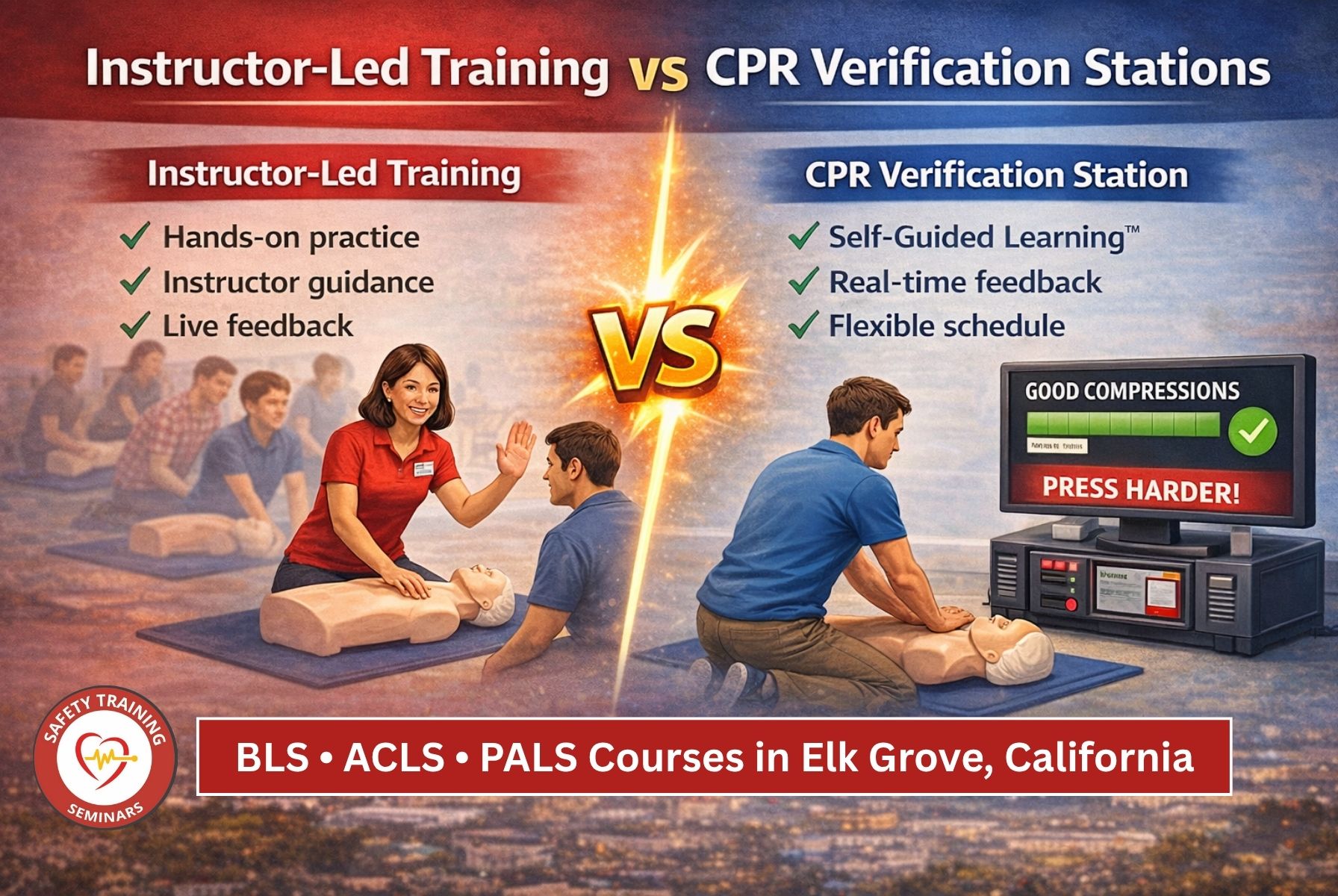
Instructor-Led vs. CPR Verification Stations: Side-by-Side Comparison
Placed directly side by side, these two formats reveal fundamentally different priorities. Instructor-led training is organized around the event — a fixed date, a fixed location, and a shared pace that applies uniformly to every person in the room regardless of their experience, specialty, or prior familiarity with the material. That standardization can support learning in the right context, particularly for participants who’ve never worked through an ACLS or PALS program before.
Self-Guided Learning™ with CPR Verification Stations is organized around the learner. HeartCode® Complete adapts content delivery based on demonstrated knowledge. The CPR Verification Station™ skills session is brief, locally bookable, and evaluated by precision technology rather than a single observer managing a room full of participants. On flexibility, time investment, scheduling control, and evaluation consistency, the Self-Guided Learning™ model holds a clear and meaningful advantage — and for the majority of Elk Grove’s working healthcare professionals, those are precisely the dimensions that matter most.
Which Option Is Better for You in Elk Grove?
Instructor-led training is the right fit if you’re completing an ACLS or PALS program for the first time and benefit from the structure of a live, trainer-guided group environment. Some participants find that working through complex clinical scenarios alongside peers — with a course instructor available for real-time questions — builds a level of confidence that’s harder to replicate independently. If your schedule allows for the commitment and you’re new to the material, this format has genuine merit.
Self-Guided Learning™ is the stronger choice if your schedule rotates, you’re renewing familiar coursework, or you simply need a more efficient path to completing your BLS class in Elk Grove, wrapping up your ACLS course, or finishing your PALS program without sacrificing days off or rearranging your entire week. For experienced clinical professionals managing the demands of life in a fast-growing community like Elk Grove, this is the format designed for how they actually live.
Local Demand for CPR BLS, ACLS, and PALS Training in Elk Grove
Elk Grove’s healthcare workforce draws from a broad and growing network of Sacramento County facilities. Dignity Health Methodist Hospital of Sacramento, Mercy General Hospital, and UC Davis Medical Center all employ large clinical teams with active AHA renewal requirements. Kaiser Permanente South Sacramento Medical Center serves the immediate south Sacramento corridor and maintains its own compliance timelines for BLS, ACLS, and PALS-trained staff. Sutter Medical Center Sacramento adds further volume to the regional renewal pipeline.
The Cosumnes Fire Department serves Elk Grove and surrounding unincorporated areas, adding first responders to the pool of professionals with active AHA training requirements. With two-year renewal cycles running continuously across all these organizations and a population that continues to grow year over year, the demand for accessible CPR training near Elk Grove shows no sign of leveling off. The shift toward flexible, technology-supported training formats reflects a workforce that has outgrown the constraints of the traditional classroom model.
How Safety Training Seminars Supports Modern CPR Training
Safety Training Seminars serves healthcare professionals throughout Elk Grove, Sacramento, Rancho Cordova, and the broader Sacramento County region by offering both instructor-led options and the Self-Guided Learning™ model supported by CPR Verification Station™ learning centers — ensuring every participant has a path that genuinely fits their schedule and professional experience.
Available programs include BLS, ACLS, PALS, NRP, and First Aid, covering the full spectrum of AHA training needs across clinical and non-clinical roles. The combination of program quality, scheduling flexibility, and accessible skills verification has made Safety Training Seminars a trusted resource for healthcare teams throughout the region — one that understands the real demands facing today’s clinical workforce and has built its offerings accordingly.
The Future of CPR Training in Elk Grove
The arc of healthcare training innovation points in one consistent direction: personalized, technology-integrated learning experiences that respect the complexity of modern clinical schedules. True Adaptive™ learning powered by Area9 Lyceum and CPR Verification Stations represent the leading edge of that arc, and the healthcare organizations across Sacramento County that have already adopted these tools are seeing measurable improvements in compliance rates, training efficiency, and learner satisfaction.
As Elk Grove continues its trajectory as one of California’s most dynamic growth cities, its healthcare workforce will need training solutions that scale alongside it. Flexible, adaptive, technology-supported learning isn’t the future of CPR BLS training in Elk Grove — it’s the present, for those who’ve already made the shift.
Start Your BLS, ACLS, or PALS Course in Elk Grove Today
Whether you’re working through a BLS course in Elk Grove for the first time or renewing your ACLS program before a compliance window closes, a training path built for your schedule is within reach. Healthcare professionals across Sacramento County — from Laguna to Stonelake, from Galt to Rancho Cordova — are already completing their programs through the Self-Guided Learning™ model, receiving their AHA Course Completion eCard, and returning to their clinical roles without the disruption and delay of a traditional classroom commitment.
Don’t let a fully booked session or an inflexible schedule push your renewal past the deadline. Choose the format that fits your professional life, complete your BLS Course in Elk Grove , ACLS in Elk Grove, or PALS training in Elk Grove on your terms, and stay current with the skills that matter most to your patients and your career.